


Product Details
Bearing Specifications
Technical Data
Overview |
|
|---|---|
| Part Number | 683 |
Characteristics |
|
| System of Measurement | Metric |
| Bearing Type | Ball |
| Seal Type | Open |
| Inner Ring Type | Standard |
| For Load Direction | Radial |
| Construction | Single Row |
| Ball Qty | 8pcs |
| Tolerance Class | ABEC1 |
Dimensions |
|
| Bore Dia (d) | 3mm |
| Bore Dia Tolerance | -0.008 to 0 |
| Outer Dia (D) | 7mm |
| Outer Dia Tolerance | -0.008 to 0 |
| Width (B) | 2mm |
| Width Tolerance | -0.12 to 0 |
| Ball Dia | 1.0mm |
| Radial Clearance | 0.005mm to 0.01mm |
| Radial Clearance Trade No | MC3 |
Material |
|
| Ring Material | Chrome Steel |
| Ball Material | Chrome Steel |
| Cage Material | Stainless Steel |
| Sealing Material | — |
Performance |
|
| Dynamic Radial Load | 0.311kN |
| Static Radial Load | 0.112kN |
| Max Speed (Grease) *1000rpm | 63 |
| Max Speed (Oil) *1000rpm | 75 |
| Temperature Range | -30° to 110° |
Properties |
|
| Lubrication | Required |
| RoHS | Compliant |
| REACH | Compliant |
| Weight | 0.32 g |
Technical Scribble

Documentation
Closures and Seals |
Cages and Retainers |
Tolerances and Precision |
Internal Clearance |
Lubrication |
Fitting and Mounting |
Load and Life Calculation Information |
eDrawings file (.ePRT, eASM) |
All information in this catalog has been thoroughly checked for accuracy. However, the catalog data should not be relied upon entirely for design and development purposes. NPBS® Bearings assumes no liability for possible errors or omissions. All dimensions and specifications are subject to change without notice. Contact NPBS® Bearings for the most current catalog data as it applies to you and for your application.
Material & Quality
SAE52100 Chrome Steel: Premium bearing steel - harder than tool steel
G10 Balls: Ultra-precision balls with ±0.25µm tolerance
High Carbon (0.95-1.05%): Superior hardness and wear resistance
Chromium (1.40-1.65%): Adds corrosion resistance and toughness
ISO Standard: Fits any bearings application worldwide
Load Rating
Dynamic Load: Maximum force while rotating. Exceeding this causes rapid wear and failure within hours.
Static Load: Maximum force when stationary. Use 80% for safety.
Calculate Your Load: Measure shaft forces, belt tensions, or gear loads. Include shock/vibration factors.
Failure Warning: Overloading causes bearing raceways to crack and balls to flatten permanently.
Speed Limits
Grease Limit: Heat generation increases exponentially above this. Grease breaks down, causing seizure.
Oil Advantage: Better heat dissipation allows higher speed. Required for high-speed spindles.
Safe Operating Speed: Use 90% of limit (52200 RPM) for maximum L10 life of 10,000+ hours.
Failure Mode: Exceeding speed causes cage failure, ball skidding, and catastrophic overheating within minutes.
Vibration Classes
V2 Grade: Standard grade - good for general applications
Low: 48μm/s; Med: 26 μm/s; High: 22μm/s
V3 Grade: Low vibration - like a smooth car engine
Low: 31μm/s; Med: 16 μm/s; High: 15μm/s
V4 Grade: Ultra-smooth - for precision instruments
Low: 28μm/s; Med: 10 μm/s; High: 10μm/s
Frequency Bands: Measured across different rotation speeds
Internal Clearance
C2 (Tight): (0-7μm) Precision applications - less play, more accurate
C0 (Normal): (2-13μm) Standard choice - works for most applications
C3 (Loose): (8-23μm) Better for hot environments - allows thermal expansion
C4 (Exta Loose): (14-29μm) Hot or tight-fit setups — extra room for thermal expansion
C5 (Max Loose): (20-37μm) Extreme heat/tight fits or near-limit speeds — maximum expansion allowance
Noise Levels
Z2 Grade: (<32db) Quiet as a library - good for most applications
Z3 Grade: (<28db) Very quiet - like a whisper (40 dB = normal whisper)
Z4 Grade: (<24db) Ultra-quiet - perfect for bedroom fans, medical equipment
Application: Ideal for sensitive environments
Product Description
683 Open Precision Miniature Ball Bearing
Key Features
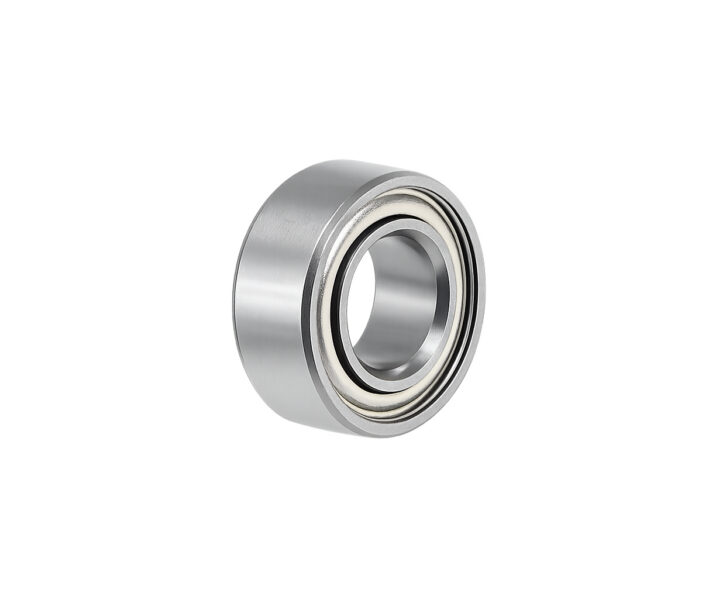
683 is a Miniature Ball Bearing manufactured to have both sides Open and is pre-lubricated with Light Oil allowing it to be ready for use upon delivery. Made from Gcr15 chrome steel, it composition optimized for small bearing applications, providing superior hardness, wear resistance, and fatigue life. 683 is a 600 Series miniature ball bearing meant for light-duty applications but despite its lightweight, can support moderate radial loads. 683 has C0 clearance standard for most applications, C3 available for high-temperature use. h6 shaft tolerance is recommended for optimal performance. Our 600 Series Mini Ball Bearings have a Larger Outer Diameter to be used in High Speed & Larger Load Capacity Applications.
Shares the 3mm bore (ID) with 693, 623, so it can be considered where the shaft is fixed at 3mm. The 683 is rated 0.311kN dynamic / 0.112kN static at 7mm OD — the most compact 3mm-bore option, below the 693 with 0.558kN dynamic / 0.180kN static and the 623 with 0.631kN dynamic / 0.219kN static. Professional installation is required for maximum 50,000-hour service life. Proper tools and techniques prevent 80% of premature failures.
- 683 Bearing – (I.D.=3mm, O.D.=7mm, Thickness=2mm).
- Bearing Steel Material – Chrome steel bearings offer excellent strength, hardness, wear resistance, and corrosion resistance, providing reliable support and optimal performance in a variety of applications.
- Open Bearings – Pre-lubricated with Light Oil allowing it to be ready for use upon delivery.
Applications / Industries
683 Miniature Ball Bearings are used in a range of applications from Electric Motors to Dental Equipment, Surgical Instruments, RC Cars, RC Helicopters, RC Planes, RC Trucks, Lab Equipment, Align Trex 600, Jewelry, Hand Piece, Radio Controlled Models, Anemometers, Small Motors, among others.
Frequently Asked Questions
Bearing Selection & Replacement
Why This Matters Proper shaft tolerance ensures correct interference fit, preventing slippage while allowing thermal expansion.
How To Handle It Measure shaft diameter with precision micrometers, ensuring it falls within h6 tolerance range before installation.
Pro Tip: Use h6 tolerance for standard applications, h5 for high-precision requirements, and h7 for loose fits.
Why This Matters Bearing dimensions are critical for proper fit, load distribution, and system performance.
How To Handle It Always use exact 683 replacement or consult engineering specifications for alternative solutions.
Pro Tip:Keep spare 683 bearings in stock to avoid production delays and ensure consistent quality.
Why This Matters Load capacity determines bearing suitability for specific applications and operating conditions.
How To Handle It Calculate actual application loads and ensure they remain within 0.311kN dynamic limit with appropriate safety factors.
Pro Tip:Use MR106-2RS bearings for applications requiring up to 0.496kN load capacity with standard safety margins.
Installation & Maintenance
Why This Matters Proper lubrication reduces friction, prevents wear, and extends bearing service life significantly.
How To Handle It Apply high-quality bearing grease during installation and maintain regular lubrication intervals based on operating conditions.
Pro Tip: Use lithium-based grease for general applications and synthetic grease for high-temperature or high-speed operations.
Why This Matters Proper installation prevents premature failure, ensures optimal performance, and maintains dimensional accuracy.
How To Handle It Use bearing heaters for interference fits, apply force evenly, and verify proper seating after installation.
Pro Tip: Professional installation tools prevent 80% of premature bearing failures and ensure maximum service life.
Why This Matters Regular maintenance prevents unexpected failures, maintains performance, and extends bearing lifespan.
How To Handle It Establish maintenance schedules based on operating conditions, document all maintenance activities, and monitor bearing condition regularly.
Pro Tip: Implement predictive maintenance using vibration analysis to detect issues before they cause failures.
Troubleshooting & Problem Solving
Why This Matters Understanding failure causes helps prevent future issues and improves system reliability.
How To Handle It Implement proper installation procedures, maintain clean environments, ensure adequate lubrication, and monitor operating conditions.
Pro Tip: 80% of premature failures are preventable through proper installation and maintenance practices.
Why This Matters Early detection of wear prevents catastrophic failures and allows for planned replacement.
How To Handle It Monitor bearing condition regularly, use vibration analysis equipment, and establish baseline performance measurements.
Pro Tip: Implement condition monitoring systems to detect wear patterns before they affect system performance.
Why This Matters Quick response prevents secondary damage and minimizes production downtime.
How To Handle It Document failure details, analyze root causes, implement corrective actions, and maintain spare bearings for critical applications.
Pro Tip: Keep detailed failure records to identify patterns and prevent similar issues in the future.
Cost & Performance Optimization
Why This Matters Total cost of ownership includes initial cost, maintenance, replacement frequency, and downtime costs.
How To Handle It Calculate total cost of ownership, consider quality vs. price trade-offs, and invest in proper installation and maintenance.
Pro Tip: High-quality bearings like 683 typically cost 20-30% more but last 3-10x longer than budget alternatives.
Why This Matters Performance directly impacts system efficiency, reliability, and overall productivity.
How To Handle It Select 683 bearings for applications requiring 3mm bore, 0.311kN load capacity, and 63,000 RPM capability.
Pro Tip: 683 bearings excel in applications requiring nano-precision performance with substantial load handling.
Why This Matters Optimized performance extends bearing life, reduces maintenance costs, and improves system reliability.
How To Handle It Follow manufacturer recommendations, implement preventive maintenance, monitor operating conditions, and use quality lubricants.
Pro Tip: Proper optimization can extend 683 bearing service life from 20,000 to 50,000+ hours in typical applications.